
Million-peso milestone: Leyte fisherfolk hit record catch with eco-friendly Lambaklad gear
By SAMAR NEWS.COM
April 30, 2026
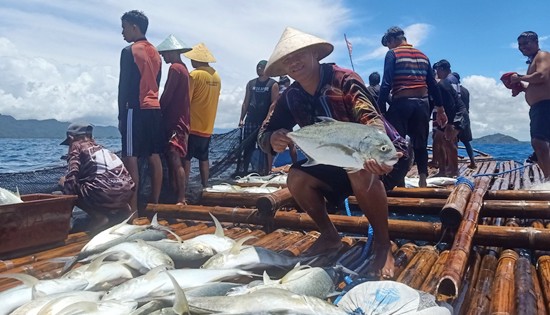
CATBALOGAN CITY – The Golden Fish Warrior Fisherfolk Association (GFWFA), a beneficiary of the Bureau of Fisheries and Aquatic Resources – Special Area for Agricultural Development (BFAR-SAAD) Program, has set a new record after earning P1,039,820.00 in gross income from a single overnight fishing operation on April 27, 2026 in the coastal waters of Tolosa, Leyte.
Using its Set Net (Lambaklad) project, the association hauled in 5.7 tons of high-value fish species, including giant trevally (Mamsa). This is now the highest recorded production since the Lambaklad project began operations in 2024.
The latest harvest also surpassed GFWFA's previous peak production of 3,032.15 kilograms recorded in November 2025, underscoring the growing productivity and profitability of the fisherfolk-managed enterprise.
Since receiving assistance under the BFAR-SAAD Program, GFWFA has accumulated a total production of 20.5 tons of high-value species, generating an overall gross income of P4,023,606.75. For the association's members, these gains translate into better incomes, more stable livelihoods, and stronger support for their families and community.
Lambaklad as a Game-Changer for Coastal Communities
The success of GFWFA is being hailed as a concrete example of how sustainable fishing technologies can uplift coastal communities while protecting the country's aquatic resources.
In line with the government's commitment to ensuring accessible and affordable food for all Filipinos, the BFAR-Capture Fisheries Division (BFAR-CFD) is actively promoting innovative and eco-friendly fishing methods that boost fish production without degrading marine ecosystems.
At the center of this effort is Lambaklad, also known as set-net, a Japanese-derived technology called otoshi-ami. The gear is being introduced in the Philippines through a collaborative initiative between government and private sector partners.
Unlike highly extractive fishing methods, Lambaklad is designed as a selective fishing approach. It uses a system of nets, floaters, and stakes to form a barrier that guides target fish into a central net, while allowing non-target and juvenile species to escape. This helps maintain ecological balance and supports the long-term sustainability of fish stocks.
Sustainable Livelihood, Stronger Food Security
BFAR's promotion of Lambaklad aims not only to improve catch volumes but also to provide a reliable and sustainable source of livelihood for fisherfolk, many of whom belong to some of the most economically vulnerable sectors in the country.
By pairing technology support with community-based management through associations like GFWFA, the program helps fisherfolk transition from small, uncertain daily catches to more organized, higher-value production systems.
The GFWFA's million-peso overnight haul illustrates how modern, sustainable fishing practices can directly benefit local communities, contribute to national food security, and ensure that the country's rich marine resources are responsibly managed for future generations.