
Church leaders call for resumption of GPH-NDFP formal talks on UN day of peace
By Philippine Ecumenical Peace Platform
September 21, 2014
MANILA - On September 21, the Philippine Ecumenical Peace Platform (PEPP), the largest ecumenical network of church leaders in the country, marked the United Nations Day of Peace by sponsoring a mass at the Malate Catholic Church in Manila. The mass was lead by PEPP co-chair Archbishop Antonio J. Ledesma, S.J., of the Archdiocese of Cagayan de Oro.
Archbishop Ledesma stated that "on this historic day, when the United Nations declared the right to peace, and as we recall the long war that has raged in our country, we call on the Government of the Philippines (GPH) and the National Democratic Front of the Philippines (NDFP) to return to the negotiating table to address the substantive issues that remain as the root cause of armed conflict in our country".
He also stated that for us Filipinos, September 21 has added significance as "it marks the anniversary of the imposition of martial law which caused many suffering”. He said that there “was unpeace during martial law and the challenge of peace building still continues as an element of our national life".
The statement of the Archbishop shows that the roots of dissent are in the deeper social realities of injustice. Peace cannot prosper without justice that restores right relationship.
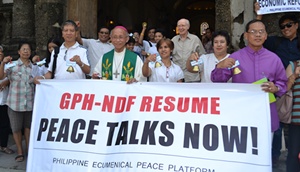
After the mass, members of the PEPP unfurled a streamer in front of the church calling for the resumption of the formal peace talks and rang bells with the same message while the church's bells were tolling. They also reiterated the call to both parties to respect the historical agreements that have already been achieved in the peace process such as the Comprehensive Agreement for Respect for Human Rights and International Humanitarian Law (CARHRIHL).
Thirty years ago, the United Nations issued the "declaration on the right to peace" which affirmed peace as a sacred right of all people and a primary prerequisite for the material wellbeing, development and the progress of countries. The United Nations declared that the "preservation of the right of people to peace and the promotion of its implementation constitute a fundamental obligation of each state."