
Ortigas names finalists of Build Forward archi-design competition
Ten most innovative designs to undergo structural review
Press Release
May 13, 2014
MANILA – Ortigas & Co. recently unveiled the names of the 10 student finalists, who topped Build Forward, a nationwide competition for the design of climate-adaptive houses and school buildings.
Earlier this year, the developer, in partnership with the Department of Science and Technology (DOST) and Habitat for Humanity Philippines, launched a landmark campaign, which challenged architecture students from different Philippine colleges and universities to come up with designs that can adapt to the changing weather conditions in the country. Three major factors were considered, namely: strength, feasibility, and innovation. The use of locally sourced and readily available materials was also encouraged.
The finalists for the house design category are:
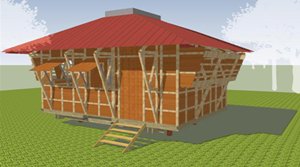
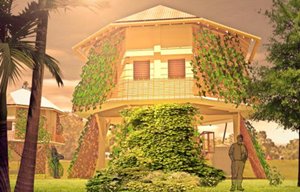
• “Haligi” by Jonie Agas and Regine Deximo, 3rd year students from UP-Diliman (advised by Arch. Nicolo del Castillo) is typical of a traditional Filipino house. The design proposes wood and bamboo as primary materials with a concrete core to serve as storage of food and emergency kits.
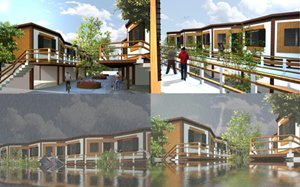
• “Bambox Hut: Amphibious Housing for Taclobenos” by Lara Therese Cruz, 5th year student from UST (advised by Arch. Jonathan Manalad), boasts of its ability to stand rigid through strong winds and earthquakes and to float in the gush of floods.
• “Bahay Panalag Laban sa Kalamidad” by Menard Navarro, Joyce Mari Linchangco, Paul Allan Bansil, and Jon Ilio are students from Mapúa (advised by Arch. Albert S. Zambrano), is made of multiple hexagonal units, a design that makes the structure more resistant to strong earthquakes and flood loads.
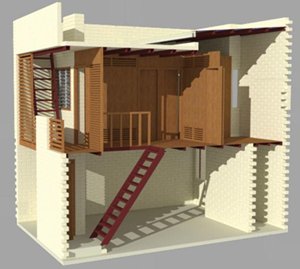
• Odessa Kaye Bulahan, 5th year student in the University of San Carlos (advised by Arch. Danilo Ravina), uses an Earth Technology called ICEB. Interlocking Compressed Earth Block (ICEB) is a cement stabilized Earth-based construction material that has high compressive strength, which could be used as a load-bearing wall or shear wall for a two or three-storey building.
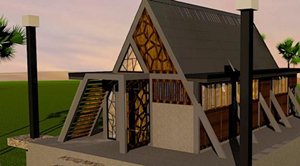
• “Neobalay” by Christian Jay Noble, 5th year student from the Technological Institute of the Philippines (advised by Arch. Simoun T. Ong), attempts to have a modified neo disaster-resilient bahay kubo that could withstand intensity 8 earthquakes and a typhoon that has a wind gust of 250 kph.
The finalists for the school design category are:
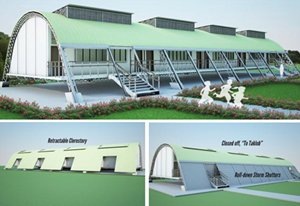
• “Taklob: A Low-Cost and Disaster Resilient School and Evacuation Center” by Mervin Afan, Corenne Martin and Rafael Khemlani, 4th year students from UP- Diliman (advised by Arch. Nicolo del Castillo), proposes a structure which can easily adapt during summer and typhoon seasons because of its openness for wind circulation as well as storm shutters.
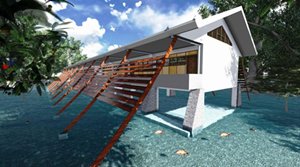
• Emmanuel Ornos, Everette Rabbon and Christopher De Vera, 4th year students from the University of Northern Philippines (advised by Arch. Fatima Alonzo), focus on elevation which can easily adapt in times of typhoons and floods.
• “Incubator: A School-Disaster Relief Structure” by Marvin Arellano and Colleen Ong , 4th year students from UP-Diliman (advised by Arch. Nicolo del Castillo), presents a plan featuring louvered vents ideal for tropical climates and a wide corridor as an activity area in times of disaster.
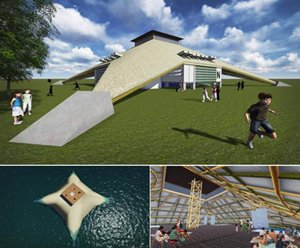
• “Talukab” by Jose Ruel Fabia, Kurt Cleon Yu and Maria Angela Luna, students also from UP-Diliman (advised by Nicolo del Castillo), is designed as a school and an evacuation with a square plan that will protect people from different types of calamities.
• Gino M. Diongzon and Michael P. Lagason, 4th year students from the University of the Assumption (advised by Erick Embang), offer collapsible walls ideal for emergency evacuations and desks, which can be converted into beds when needed.
The said designs will be sent to Magnusson Klemencic Associates, based in Seattle, Washington, USA and Rowan Williams Davies & Irwin (RWDI) Consulting Engineers and Scientists headquarters in Guelph, Ontario, Canada to undergo structural review by experts, and the designs will also be reviewed by experts in the Philippines. The winning entry will be used by Habitat for Humanity Philippines in the construction of new houses in Yolanda-ravaged areas.
“In less than two months since we launched the competition, we were able to generate more than 100 entries from architecture students in different colleges and universities across the Philippines. Finalist selection proved rather tough because of the excellent quality of designs we received. The future of architecture in the Philippines is looking bright, and so are the prospects for an ongoing campaign to Build Forward,” says Joey F. Santos, General Manager of the Real Estate Division, Ortigas & Co.
All designs are posted online atwww.buildforward.com.ph and are public documents, which every designer can build on. The grand winner will be announced early June. For more updates, like Build Forward on Facebook, or follow its twitter handle @BuildForwardPH.
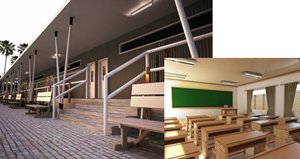
DESIGN PERSPECTIVE

Related article: DOST, Ortigas, Habitat for Humanity join forces to build climate-adaptive houses
More News: